
DEVELOPMENT
Fuel Subsidy: Oil Expert Tells Tinubu What He Must Do as Nigerians Groan Under High Petrol Prices

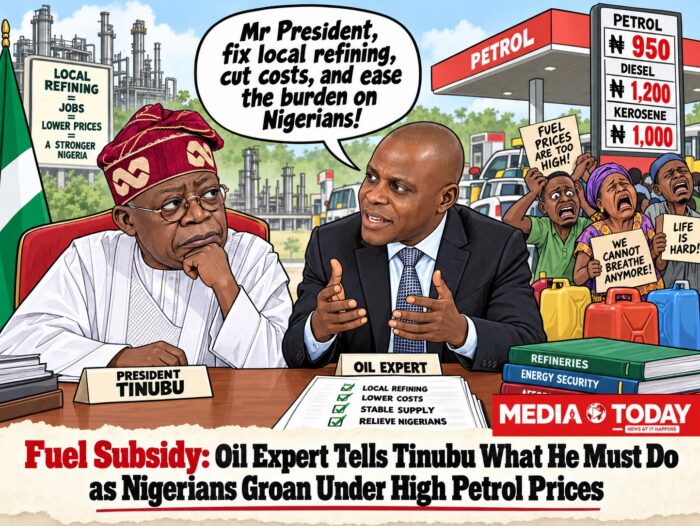
Fuel Subsidy: Oil Expert Tells Tinubu What He Must Do as Nigerians Groan Under High Petrol Prices
An oil and gas expert, Nick Agule, has urged President Bola Tinubu to reconsider the removal of petrol subsidy, arguing that the policy should be accompanied by measures to cushion its impact on Nigerians.
Agule made the call during an interview on Arise TV’s Morning Show, monitored by Media Today, while responding to questions on the rising cost of petrol and the hardship being experienced by Nigerians.
He said the government could reintroduce a form of subsidy while simultaneously tackling the alleged corruption and leakages that previously plagued the subsidy regime.
According to him, smuggling of petroleum products across Nigeria’s borders and fraudulent subsidy claims were among the problems that contributed to the failure of the former system.


Agule argued that the government could address such practices through stricter enforcement and prosecution of officials or individuals found culpable.
He, however, said that if President Tinubu remained unwilling to reverse the subsidy removal, the government must introduce measures capable of reducing the burden on citizens.
“Removal of fuel subsidy was like the President performing a surgical operation. It is a good thing that he did it, but if you are performing surgery without anesthesia, you can actually kill your patient on the operating table,” Agule said.
He identified electricity supply as one area where the government could provide relief, arguing that improved power supply would reduce the cost pressures faced by businesses and households.
Agule also criticised the Nigerian National Petroleum Company Limited (NNPCL), describing it as a major problem within Nigeria’s petroleum sector.
He argued that the country’s continued reliance on trucks to transport petroleum products over long distances was contributing to costs and exposing the distribution system to risks.
According to him, Nigeria has an extensive pipeline network that could be utilised to transport petroleum products more efficiently, but many of the pipelines have remained largely inactive.
Agule further called for a restructuring of NNPCL, arguing that the company should be unbundled and subjected to stronger private-sector participation.
“It is not just about changing their name from NNPC to NNPCL. It is about unbundling that company and putting it on the capital market the way Dangote Refinery is going onto the capital market,” he said.
During the programme, Arise TV anchor Rufai Oseni challenged Agule’s reference to the old subsidy system, arguing that the system involving questionable subsidy claims had already been restructured following the recommendations of the Aig-Imoukhuede-led Presidential Committee on Fuel Subsidy Payments.
Oseni instead questioned the accountability of NNPCL over the billions of dollars reportedly committed to the rehabilitation of Nigeria’s state-owned refineries.
Available reporting puts the combined contracts for the rehabilitation of the Port Harcourt, Warri and Kaduna refineries at about $3 billion, with questions continuing over their performance and financial sustainability.
Agule agreed with Oseni’s concerns about NNPCL, saying the national oil company controls significant upstream, refinery, pipeline and gas assets that could be better utilised.
The discussion also touched on the impact of global crude oil prices and foreign exchange movements on the domestic price of petrol, with Agule questioning why Nigerian consumers should bear the full impact of international market disruptions despite the country being an oil-producing nation.
The comments come amid continuing public debate over petrol prices, refinery operations, NNPCL’s role in the downstream petroleum sector and the broader economic consequences of the removal of fuel subsidy.
The Aig-Imoukhuede committee, established during the previous subsidy regime, was specifically tasked with verifying and reconciling fuel subsidy payments, and its work identified significant irregularities in subsidy claims.


